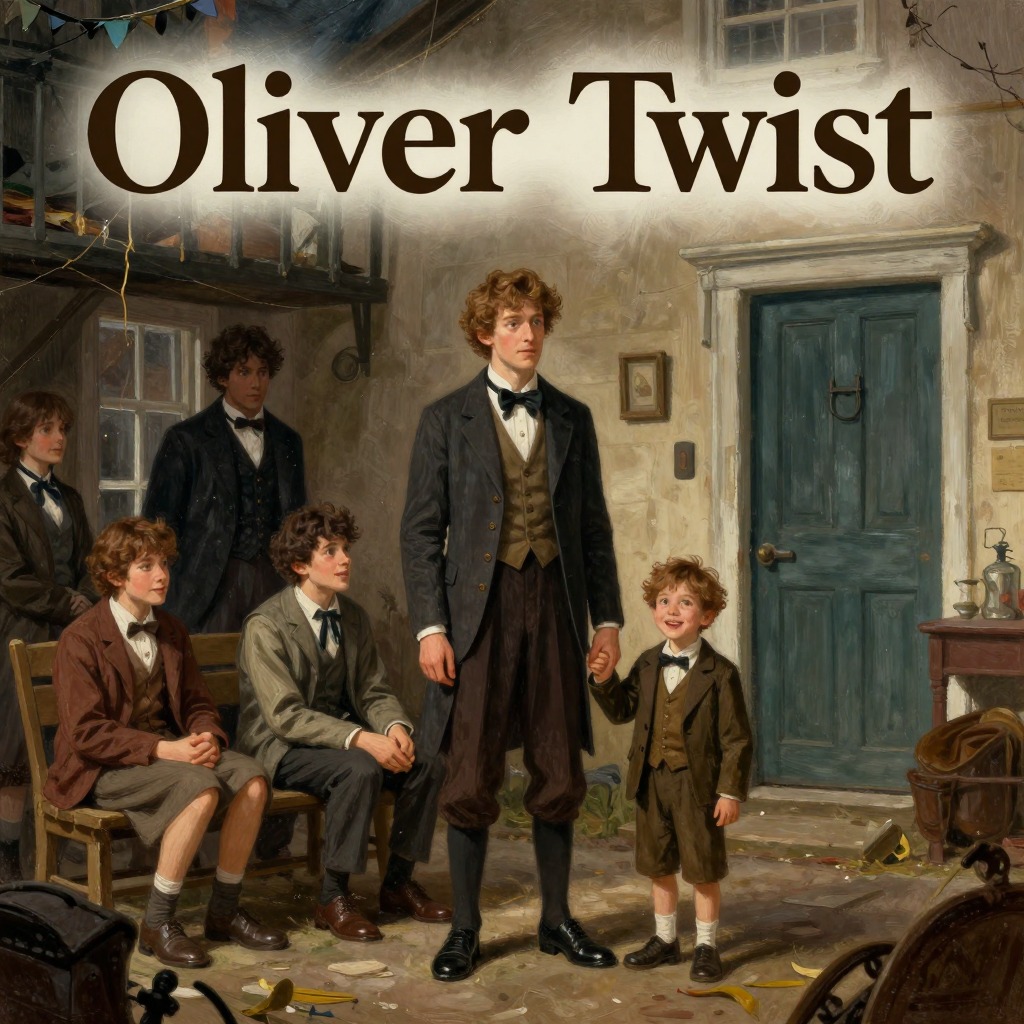
Opening of the story
Oliver Twist's Birth
Oliver Twist is born in a workhouse in a provincial English town. His mother, a young woman found lying in the street, dies immediately after giving birth, leaving the infant an orphan. The parish surgeon and a drunken nurse attend the birth, and the surgeon notes the absence of a wedding ring on the mother's finger, confirming the child's illegitimacy. This event establishes Oliver's foundational identity as a parish orphan, setting the stage for his lifelong struggle against poverty, neglect, and the cruel institutions of the Poor Law.
Shortly after birth
Oliver Sent to Mrs. Mann's Farm
The parish authorities decide to 'farm' Oliver out to a branch workhouse run by Mrs. Mann, a woman who receives a small weekly stipend per child. Mrs. Mann systematically starves and neglects the infants in her care, appropriating most of the money for herself. Many children die under her supervision, but Oliver survives, though he remains pale, thin, and small for his age. This period of deprivation hardens Oliver's body and spirit, preparing him for the further hardships he will face.
Oliver's ninth birthday
Oliver's Ninth Birthday and Mr. Bumble's Visit
On Oliver's ninth birthday, Mr. Bumble, the parish beadle, visits Mrs. Mann's farm to inform her that Oliver is to be returned to the main workhouse. Bumble reveals that he invented the surname 'Twist' by following an alphabetical naming system for foundlings. Oliver is taken away from the only home he has known, experiencing a profound sense of loneliness as he leaves behind his only friends, the other pauper children. This event marks Oliver's transition from the relative obscurity of the farm to the more public and harsh world of the workhouse.
Immediately after returning to the workhouse
Oliver Appears Before the Board
Oliver is brought before the parish board, a group of fat, self-important gentlemen who question him about his identity and his understanding of being an orphan. The gentleman in the white waistcoat immediately declares Oliver a fool. The board decides that Oliver is to be educated and taught a useful trade, which means he will begin picking oakum at six o'clock the next morning. Oliver is then led to a large ward where he sobs himself to sleep on a hard bed, unaware that the board has already made a decision that will profoundly shape his future.
After three months of semi-starvation
Oliver Asks for More Gruel
The workhouse boys, suffering from slow starvation, draw lots to determine who will ask for an additional portion of gruel. The lot falls to Oliver. That evening, after finishing his meager supper, Oliver approaches the master, bowl in hand, and utters the famous line: 'Please, sir, I want some more.' The master is stupefied, then strikes Oliver and calls for the beadle. The board is horrified, and the gentleman in the white waistcoat famously predicts that Oliver will be hanged. As punishment, Oliver is confined to a dark, solitary room, and a notice is posted offering a reward of five pounds to anyone who will take him as an apprentice.
A week after asking for more
Oliver Nearly Apprenticed to Mr. Gamfield
Mr. Gamfield, a brutal chimney sweep, sees the advertisement for Oliver and decides to take him on as an apprentice, seeing the five-pound premium as a way to pay his rent. The board, after some haggling, agrees to a reduced premium of three pounds ten shillings. Oliver is brought before a magistrate to sign the indentures. The magistrate, half-blind and half-childish, is about to approve the apprenticeship when he notices the terror on Oliver's face. Questioning the boy, Oliver falls to his knees and begs to be sent back to the dark room rather than go with the dreadful Mr. Gamfield. The magistrate refuses to sanction the indentures, saving Oliver from a life of brutal servitude.
Shortly after the Gamfield incident
Oliver Apprenticed to Mr. Sowerberry
The board, having failed to apprentice Oliver to a sweep, considers sending him to sea. However, Mr. Sowerberry, the parochial undertaker, offers to take Oliver as an apprentice. Oliver is informed of his new fate and, showing little emotion, is led away by Mr. Bumble to the undertaker's shop. He is introduced to Mrs. Sowerberry, who is displeased with his small size, and is given a meal of dog's leftovers. His bed is placed under the counter, among the coffins, a grim introduction to his new trade. This event marks Oliver's first entry into 'public life' as a working boy.
Oliver's first morning at the undertaker's
Oliver Meets Noah Claypole
Oliver is awakened by a loud kicking at the door and meets Noah Claypole, a charity boy who is older and larger than Oliver. Noah immediately establishes his dominance, bullying Oliver and forcing him to do menial tasks. Noah, himself a victim of bullying from other boys, takes out his frustrations on the helpless Oliver. This introduces the theme of the weak preying on the weaker, a recurring pattern in Oliver's early life. Oliver also meets Charlotte, the maidservant, who joins Noah in mistreating him.
A few weeks into his apprenticeship
Oliver Attends His First Funeral
Mr. Sowerberry, recognizing the melancholy expression on Oliver's face, decides to use him as a 'mute' for children's funerals. Oliver accompanies his master to the funeral of a woman who has died of starvation. He witnesses the profound grief of the widower and the grotesque indifference of the old grandmother, who treats the death as a form of entertainment. The funeral itself is a rushed, callous affair, with the clergyman compressing the service into four minutes. This experience gives Oliver a deeply unfavorable impression of his master's business and the callousness of the world.
Several months into his apprenticeship
Oliver Fights Noah Claypole
Noah, goaded by jealousy over Oliver's promotion to a more visible role in funerals, taunts Oliver about his mother, calling her a 'regular right-down bad 'un.' This insult to his dead mother ignites a fierce rage in Oliver. He attacks Noah, knocking him to the ground. Charlotte and Mrs. Sowerberry rush in and subdue Oliver, beating and scratching him. They lock him in the cellar. This is a pivotal moment, as it marks the first time Oliver actively rebels against his oppressors, revealing a hidden strength and spirit beneath his meek exterior.
The night after the fight
Oliver Runs Away to London
After being locked in the cellar and later beaten by Mr. Sowerberry, Oliver is left alone in the dark workshop. Overwhelmed by misery and a sense of injustice, he decides to run away. He packs his few belongings and, at the first light of dawn, slips out of the house and into the open street. He walks towards London, the great city where he believes he can disappear and find a better life. Before leaving, he stops to say goodbye to his friend Dick, a sickly boy from the workhouse who gives him his blessing. This event sets the entire main plot of the novel in motion.
Seven days after leaving home, in Barnet
Oliver Meets the Artful Dodger
After a week of walking, starving, and begging, Oliver limps into the town of Barnet, exhausted and desperate. He is approached by a strange, streetwise boy his own age, who introduces himself as Jack Dawkins, better known as the Artful Dodger. The Dodger, recognizing Oliver's naivety, offers to buy him food and take him to a 'spectable old gentleman' in London who will provide him with lodging. Oliver, grateful and trusting, accepts the offer, unaware that he is being recruited into a gang of child thieves. This encounter is the beginning of Oliver's descent into the criminal underworld of London.
The same night, late
Oliver Taken to Fagin's Den
The Dodger leads Oliver through the dark, filthy streets of London's East End to a dilapidated house in Field Lane, near Saffron Hill. There, Oliver is introduced to Fagin, a 'very old shriveled Jew' who presides over a gang of boy thieves. The room is filled with stolen handkerchiefs and other loot. Fagin and the boys greet Oliver with a mixture of false welcome and menacing curiosity. Oliver is given food and drink, and then falls into a deep sleep on a sack, now firmly in the clutches of the criminal gang. This marks Oliver's entry into Fagin's den, the center of the novel's criminal world.
The next morning
Oliver Witnesses Fagin's Hidden Treasure
Oliver wakes to find Fagin alone in the room, preparing breakfast. Feigning sleep, Oliver watches as Fagin retrieves a hidden box containing a magnificent gold watch, jewels, and other valuables. Fagin mutters to himself about the glories of capital punishment and the loyalty of his 'clever dogs' who have been hanged. He catches Oliver watching him and reacts with violent suspicion, threatening him with a bread knife before calming down and pretending it was all a game. This scene reveals the true nature of Fagin's operation and the source of his wealth, and it plants the first seeds of suspicion in Oliver's mind.
Later that morning
Oliver Learns the Pickpocket's Game
After breakfast, Fagin and the boys play a curious game in which Fagin pretends to be a gentleman walking down the street, and the Dodger and Charley Bates practice picking his pockets without his knowledge. Oliver, finding the game amusing, laughs heartily. Fagin then teaches Oliver how to remove a handkerchief from his own pocket without being felt. Oliver, still innocent of the game's true purpose, learns the basic mechanics of pickpocketing. This training is a crucial step in Fagin's plan to corrupt Oliver and turn him into a thief.
After several days of training
Oliver Goes Out with the Dodger and Charley
Eager for fresh air and to prove himself, Oliver finally obtains Fagin's permission to go out 'to work' with the Dodger and Charley Bates. The three boys saunter through the streets of Clerkenwell. The Dodger and Charley engage in petty theft, stealing apples and onions, which disturbs Oliver. They then spot an old gentleman reading at a bookstall. The Dodger picks the gentleman's pocket, stealing a handkerchief, and he and Charley immediately flee. Oliver, horrified and realizing the truth about his companions, panics and runs, only to be mistaken for the thief by the pursuing crowd.
Immediately after the theft
Oliver Arrested for Pickpocketing
Oliver is chased through the streets by a mob shouting 'Stop thief!' He is eventually caught, knocked to the ground, and dragged before the police. The old gentleman, Mr. Brownlow, is brought to the scene and, despite his initial certainty, begins to doubt Oliver's guilt. Oliver is taken to the police office of the notorious magistrate Mr. Fang, who presumes him guilty and treats him with contempt. Oliver, weak and terrified, faints in the courtroom. This event leads to Oliver's first encounter with the justice system and his rescue by Mr. Brownlow.
During the court hearing
Oliver Discharged and Taken by Mr. Brownlow
Just as Mr. Fang is about to sentence Oliver to three months of hard labor, the book-stall keeper rushes into the court and testifies that he saw the robbery was committed by two other boys, not Oliver. Mr. Brownlow, realizing his mistake, is furious with the magistrate. Oliver is discharged, but he has collapsed from illness. Mr. Brownlow, feeling a strange connection to the boy, takes him home in a coach. This is a turning point in Oliver's life, as he is rescued from the clutches of the law and the criminal gang and brought into a world of kindness and comfort.
The following days and weeks
Oliver Recovers at Mr. Brownlow's Home
Oliver is taken to Mr. Brownlow's neat house in Pentonville, where he is nursed back to health by the kind housekeeper, Mrs. Bedwin. He suffers a severe fever and is bedridden for many days. During his recovery, he is drawn to a portrait of a beautiful lady that hangs in the room, feeling a strange, sorrowful connection to it. Mr. Brownlow notices a striking resemblance between Oliver and the portrait. This period of care and kindness is Oliver's first experience of a loving home, and it deepens the mystery of his parentage.
While Oliver is at Mr. Brownlow's
Fagin and the Gang Plot Oliver's Recapture
Back in Fagin's den, the Dodger and Charley Bates report Oliver's capture. Fagin is furious and terrified that Oliver might betray them. He and the brutal housebreaker Bill Sikes discuss the need to recapture Oliver to prevent him from 'peaching.' They decide to use Nancy, Sikes's companion, to find out what has happened to Oliver. Nancy, despite her loyalty to the gang, shows the first signs of reluctance. This plot sets the stage for Oliver's inevitable return to the criminal underworld.
The same day
Nancy Tracks Oliver to Pentonville
Nancy, disguised with a clean apron and a basket, goes to the police office and, feigning to be Oliver's heartbroken sister, learns that he has been taken away by a gentleman to Pentonville. She reports this information back to Fagin and Sikes. Sikes immediately leaves to begin searching for Oliver. Fagin, now desperate, orders the boys to skulk about and find Oliver's whereabouts. The net begins to close around Oliver, threatening his newfound safety.
A week after Oliver's recovery
Mr. Grimwig's Prediction and Oliver's Errand
Mr. Brownlow's eccentric friend, Mr. Grimwig, visits and expresses deep skepticism about Oliver's character, predicting that he will prove to be a bad boy. To test Oliver's honesty, Mr. Brownlow sends him on an errand to return some books and pay a five-pound note to the bookstall keeper. Mr. Grimwig wagers that Oliver will not return, declaring he will 'eat his head' if the boy comes back. Oliver, eager to prove himself, sets off on the errand, unaware that he is walking into a trap set by Fagin and Sikes.
While on the errand
Oliver Recaptured by Nancy and Sikes
As Oliver walks through Clerkenwell, he is suddenly accosted by Nancy, who pretends to be his sister and claims he has run away from his grieving parents. A crowd gathers, and before Oliver can protest, Bill Sikes appears with his dog, Bull's-eye. Sikes violently seizes Oliver, strikes him, and drags him away through the dark streets. Oliver's cries for help are ignored by the bystanders, who believe the story of the 'wayward boy.' He is forcibly returned to the criminal world, his hopes of a new life with Mr. Brownlow shattered.
The same night
Oliver Returned to Fagin's Den
Sikes and Nancy drag Oliver through Smithfield market to a new, secret hideout. There, they are greeted by Fagin, the Dodger, and Charley Bates, who mock Oliver's fine new clothes and the books he was carrying. Fagin and Sikes argue over the five-pound note, which Sikes claims for himself. Oliver, in despair, begs them to return the books and money to Mr. Brownlow, but Fagin only laughs, knowing that the theft will confirm Mr. Brownlow's worst suspicions. Oliver is stripped of his new clothes and locked in a dark room, his brief period of happiness now a distant memory.
Later that night
Nancy Protects Oliver from a Beating
When Oliver attempts to escape and call for help, Sikes sets his dog on him. Nancy, in a surprising act of defiance, throws herself between Oliver and the dog, preventing the attack. She then wrests a club from Fagin's hand and throws it into the fire, declaring she will not stand by and see Oliver beaten. This is the first major sign of Nancy's internal conflict and her growing sympathy for Oliver. Her intervention saves Oliver from immediate harm, but it also marks her as a potential traitor in the eyes of Fagin and Sikes.
Shortly after Oliver's recapture
Mr. Bumble Goes to London and Meets Mr. Brownlow
Mr. Bumble travels to London on parish business. While there, he sees Mr. Brownlow's advertisement offering a reward for information about Oliver. He goes to Mr. Brownlow's house and, motivated by the reward, delivers a damning account of Oliver's character, portraying him as a vicious, ungrateful, and treacherous foundling from a low and vicious family. Mr. Brownlow, heartbroken, is convinced of Oliver's guilt and orders Mrs. Bedwin never to mention the boy's name again. This event solidifies the false narrative of Oliver's wickedness and deepens the mystery surrounding his past.
The following weeks
Oliver is Groomed for a Life of Crime
Fagin keeps Oliver confined to the house, subjecting him to long lectures on the sin of ingratitude and the dangers of betraying the gang. He tells Oliver stories of other boys who were hanged for trying to inform on him. The Dodger and Charley Bates try to persuade Oliver to join their trade, arguing that it is a 'jolly life.' Fagin slowly and deliberately poisons Oliver's mind, using solitude, fear, and twisted logic to break his spirit and make him compliant. This period represents Fagin's systematic attempt to corrupt Oliver's soul.
A few weeks later
Fagin and Sikes Plan the Chertsey Burglary
Fagin visits Sikes to discuss a planned burglary at a house in Chertsey. The original plan has failed because the servants cannot be bribed. Sikes proposes a new plan to break in from the outside, but he needs a small boy to climb through a tiny window. Fagin suggests Oliver, seeing it as the perfect opportunity to implicate him in a serious crime and bind him forever to the gang. Nancy is present and, despite her earlier defiance, seems to go along with the plan. This decision sets the stage for the most dangerous event in Oliver's young life.
The night before the burglary
Oliver Delivered to Bill Sikes
Fagin tells Oliver that he is to be taken to Sikes's house. Oliver is terrified but cannot resist. Nancy comes to fetch him, and despite her own misgivings, she leads him away. At Sikes's lodging, Sikes threatens Oliver with a pistol, warning him that he will be shot if he makes a sound or tries to escape. Oliver is forced to spend the night there, and early the next morning, Sikes leads him out into the dark, rainy streets to begin the journey to Chertsey. This marks the point of no return for Oliver's involvement in the burglary.
Early morning
The Journey to Chertsey
Sikes and Oliver travel through the waking city, passing through Smithfield market and then taking a cart to Hampton. They walk through the countryside, stopping at a public house for dinner, where Oliver falls asleep from exhaustion. They then continue their journey by cart, passing through Sunbury and Shepperton in the dark. Oliver, terrified and bewildered, fears that Sikes has brought him to a lonely place to murder him. Finally, they arrive at a solitary, ruinous house, which is their destination. The journey is a harrowing experience for Oliver, filled with fear and uncertainty.
Late that night
The Burglary at Chertsey
Sikes and his accomplice, Toby Crackit, force Oliver to climb through a small window into the house to unlock the front door for them. Oliver, realizing he is being used for a burglary, resolves to alarm the family instead. As he creeps towards the stairs, Sikes senses his intention and shouts for him to come back. The alarm is raised; a shot is fired from inside the house, and Oliver is hit and wounded. Sikes and Crackit drag him back through the window and flee, leaving Oliver bleeding and unconscious in a ditch. This event is the climax of Oliver's victimization by the gang.
Immediately after the burglary
Oliver is Left for Dead
As the household raises the alarm and pursuers close in, Sikes and Crackit carry the wounded Oliver across the fields. When they realize he is badly hurt and slowing them down, they abandon him in a ditch, believing him to be dead or dying. Sikes and Crackit then separate and flee for their own lives. Oliver lies alone, unconscious and bleeding, in the cold, wet ditch. This moment of utter abandonment is the lowest point in Oliver's journey, but it also sets the stage for his rescue by the very people he was forced to rob.
The next morning
Oliver is Found and Taken In by the Maylies
After a night of agony, Oliver regains consciousness and, in a daze, stumbles towards the house that was burgled. He collapses at the door. The servants, Mr. Giles and Brittles, initially mistake him for one of the thieves and capture him. However, the mistress of the house, Mrs. Maylie, and her beautiful niece, Rose, take pity on him. They have him carried inside and send for a doctor. Oliver, weak and wounded, is taken into the care of the very family he was forced to rob, beginning a new chapter of his life.
The following weeks
Oliver Recovers with the Maylies
Under the care of Mrs. Maylie, Rose, and the eccentric but kind Dr. Losberne, Oliver slowly recovers from his wound and the subsequent fever. He tells them his entire history, and they believe him. Dr. Losberne cleverly manages to convince the local constable and the Bow Street officers, Blathers and Duff, that Oliver is an innocent victim, not a criminal. Oliver is finally free from the threat of the law and begins to experience a life of peace, kindness, and genuine affection. This period marks his true rescue and the beginning of his happy life.
Spring and summer
Oliver's Happy Life in the Country
After his recovery, Oliver accompanies the Maylies to a cottage in a beautiful, peaceful village. He thrives in the fresh air and natural surroundings, learning to read and write under the tutelage of a kind old clergyman. He spends his days helping in the garden, walking with Rose, and listening to her play the piano. This idyllic period is the happiest of Oliver's life, a stark contrast to the misery of the workhouse and the terror of the criminal underworld. He becomes deeply attached to his benefactors, especially Rose.
Summer
Rose Maylie Falls Ill
One evening, Rose suddenly becomes ill, showing signs of a dangerous fever. Mrs. Maylie is terrified, fearing she will lose the girl she loves like a daughter. Oliver is sent on a desperate errand to the market town to summon Dr. Losberne. Rose's condition worsens rapidly, and the local doctor pronounces that her recovery would be a miracle. The household is plunged into grief and suspense. This crisis tests the bonds of the little family and introduces a new source of tension.
After a period of crisis
Rose Recovers and Harry Maylie Arrives
After a long and anxious struggle, Rose's fever breaks, and she begins to recover. Dr. Losberne announces that she will live. Overjoyed, Oliver goes out to gather flowers and meets a post-chaise carrying Harry Maylie, Mrs. Maylie's son. Harry, who is deeply in love with Rose, has rushed to her bedside upon hearing of her illness. His arrival brings a new dynamic to the household, as his feelings for Rose and his mother's concerns about their different social stations come to the forefront.
A few days later
Harry Maylie Proposes to Rose
Harry Maylie proposes marriage to Rose, but she refuses him. She explains that she is a friendless, portionless girl with a stain upon her name (her unknown parentage) and that she will not bring disgrace upon him or his family. Harry argues passionately that he loves her and does not care about her origins, but Rose remains firm in her decision, though it causes her great pain. This rejection sets up a central romantic conflict and deepens the mystery of Rose's own history.
One evening during Rose's recovery
Oliver Sees Fagin and Monks at the Window
While studying in his room one evening, Oliver falls asleep and has a terrifying dream. He wakes to find Fagin and another man, Monks, peering in at his window. They recognize him, and he recognizes them. Oliver cries out for help, but the men vanish. A search of the grounds reveals no trace of them. This event shatters the peace of the cottage and reintroduces the threat of the criminal world. It also introduces Monks as a mysterious and sinister figure who is connected to Fagin and has a specific interest in Oliver.
A Sunday night, weeks later
Nancy's Secret Meeting with Rose Maylie
Nancy, driven by guilt and a desire to protect Oliver, arranges a secret meeting with Rose Maylie on London Bridge. She reveals that Monks is Oliver's half-brother and that he and Fagin have conspired to destroy Oliver and keep his inheritance. Nancy refuses to betray Sikes, but she provides crucial information about Monks and his plans. Rose, deeply moved, promises to keep Nancy's secret and to use the information to help Oliver. This is the pivotal act of Nancy's redemption and sets the final plot in motion.
Around the same time
Noah Claypole Joins Fagin's Gang
Noah Claypole and Charlotte, having robbed Mr. Sowerberry, flee to London. They seek shelter at the Three Cripples public house, where Fagin overhears them. Recognizing Noah's potential as a sneaking informer, Fagin recruits him into the gang, giving him the alias 'Mr. Bolter.' Noah is assigned to the 'kinchin lay' (robbing children) and is later tasked by Fagin with spying on Nancy. This subplot introduces a new, despicable character into the criminal world and provides the means for Fagin to discover Nancy's betrayal.
The following week
Fagin Sets Noah to Spy on Nancy
Fagin, suspicious of Nancy's changed behavior and her desperate desire to leave the house on Sunday nights, orders Noah to follow her. Noah, disguised as a countryman, shadows Nancy to her secret meeting on London Bridge with Rose and Mr. Brownlow. He hides on the stairs and overhears the entire conversation, learning of Nancy's betrayal and the plot against Monks. He then rushes back to report everything to Fagin. This act of surveillance seals Nancy's fate.
Later that night
Fagin Tells Sikes of Nancy's Betrayal
Fagin, enraged by Nancy's betrayal, waits for Sikes to return. He tells Sikes that Nancy has 'peached' on them all, revealing their plans and descriptions to outsiders. He goads Sikes by describing how Nancy gave him laudanum to sneak out. Sikes, in a fit of blind fury, rushes out of Fagin's house, determined to confront and kill Nancy. Fagin's manipulation of Sikes is the final, most despicable act of his villainy, directly leading to the novel's most tragic event.
The same night
Sikes Murders Nancy
Sikes returns to his room where Nancy is waiting. He confronts her with her betrayal. Nancy, realizing she is about to die, does not deny it but begs for her life and pleads with him to repent and escape with her. Sikes, in a frenzy of rage, beats her to death with a pistol. He then tries to cover up the crime, burning the club and washing the blood from his clothes, but the ghost of his victim haunts him. This is the most violent and tragic event in the novel, marking the point of no return for Sikes and the culmination of the gang's evil.
The following days
Sikes's Flight and Haunted Journey
After the murder, Sikes flees London, wandering the countryside in a state of terror. He is haunted by the vision of Nancy's dead eyes, which follow him everywhere. He tries to lose himself in the crowd at a fire, but the guilt and fear are inescapable. He resolves to return to London to hide, but his dog, Bull's-eye, sensing his master's murderous intent, abandons him. Sikes's flight is a descent into madness and paranoia, a psychological portrait of a murderer's guilt.
The same period
Mr. Brownlow Confronts Monks
Mr. Brownlow, armed with the information from Nancy, has Monks kidnapped and brought to his house. He confronts Monks with the truth about his parentage and his conspiracy with Fagin. Mr. Brownlow reveals that he was a close friend of Monks's father, Edwin Leeford, and knows the whole story of the tragic love affair with Agnes Fleming. He forces Monks to confess and to sign a document restoring Oliver's inheritance. This scene unravels the central mystery of the novel and brings the villains to justice.
The following night
Sikes's Last Stand at Jacob's Island
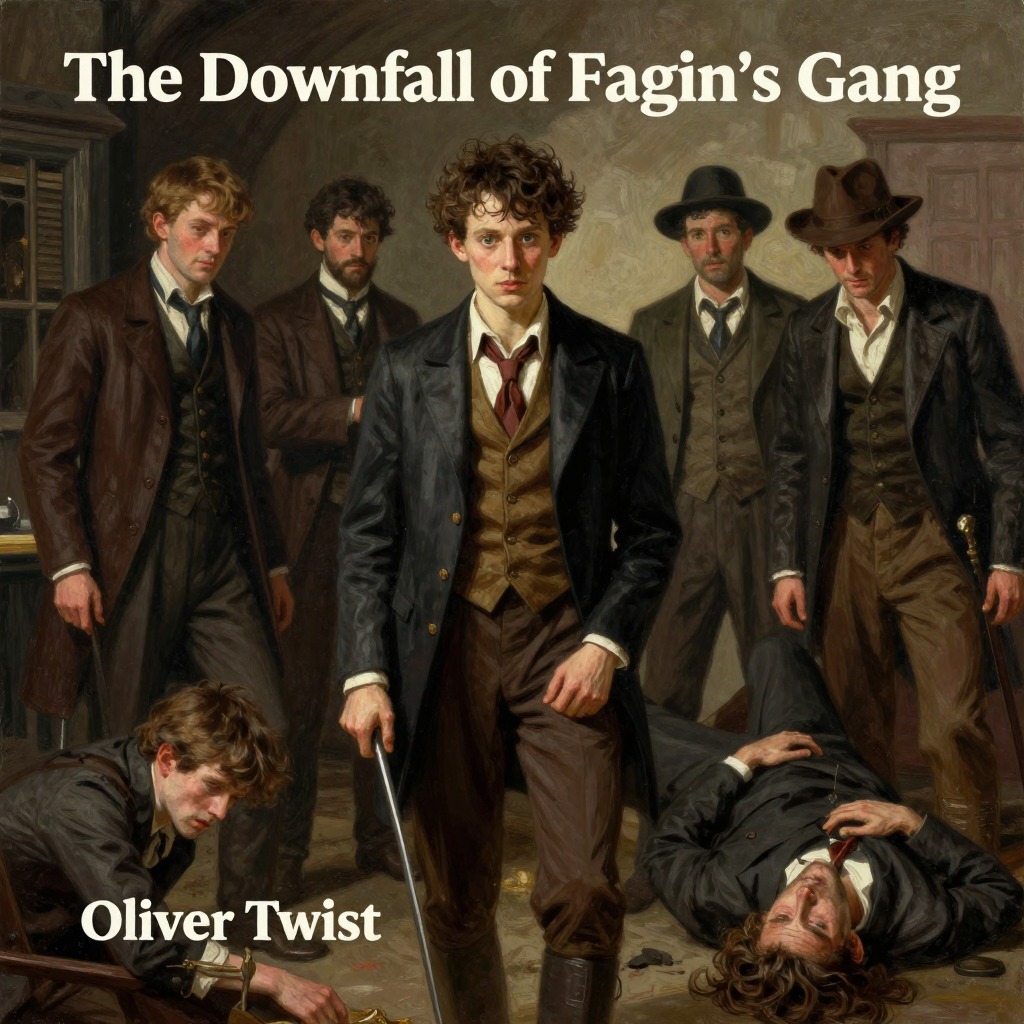
Sikes returns to London and seeks refuge in a squalid hideout on Jacob's Island, a filthy slum in Southwark. He is joined by Toby Crackit and other criminals, but they are all terrified of him. Charley Bates, horrified by the murder, tries to raise the alarm. A massive crowd, led by Mr. Brownlow and Harry Maylie, surrounds the building. Sikes, trapped, attempts to escape by lowering himself from the roof with a rope. As he does so, he is startled by the vision of Nancy's eyes, loses his balance, and accidentally hangs himself. The dog Bull's-eye, trying to follow, falls and dies. This is the dramatic and fitting end for the murderer.
Shortly after Sikes's death
Fagin's Trial and Last Night
Fagin is arrested and put on trial for his crimes. He is found guilty and sentenced to death. On his last night in Newgate prison, he is visited by Mr. Brownlow and Oliver. Fagin, now a broken and terrified man, raves and clutches at Oliver, but he provides the location of the hidden papers that prove Oliver's identity. The scene is a powerful depiction of a condemned man's psychological torment and the final defeat of evil. Oliver, despite everything, prays for Fagin's soul.
At the final gathering
Oliver's Parentage Revealed
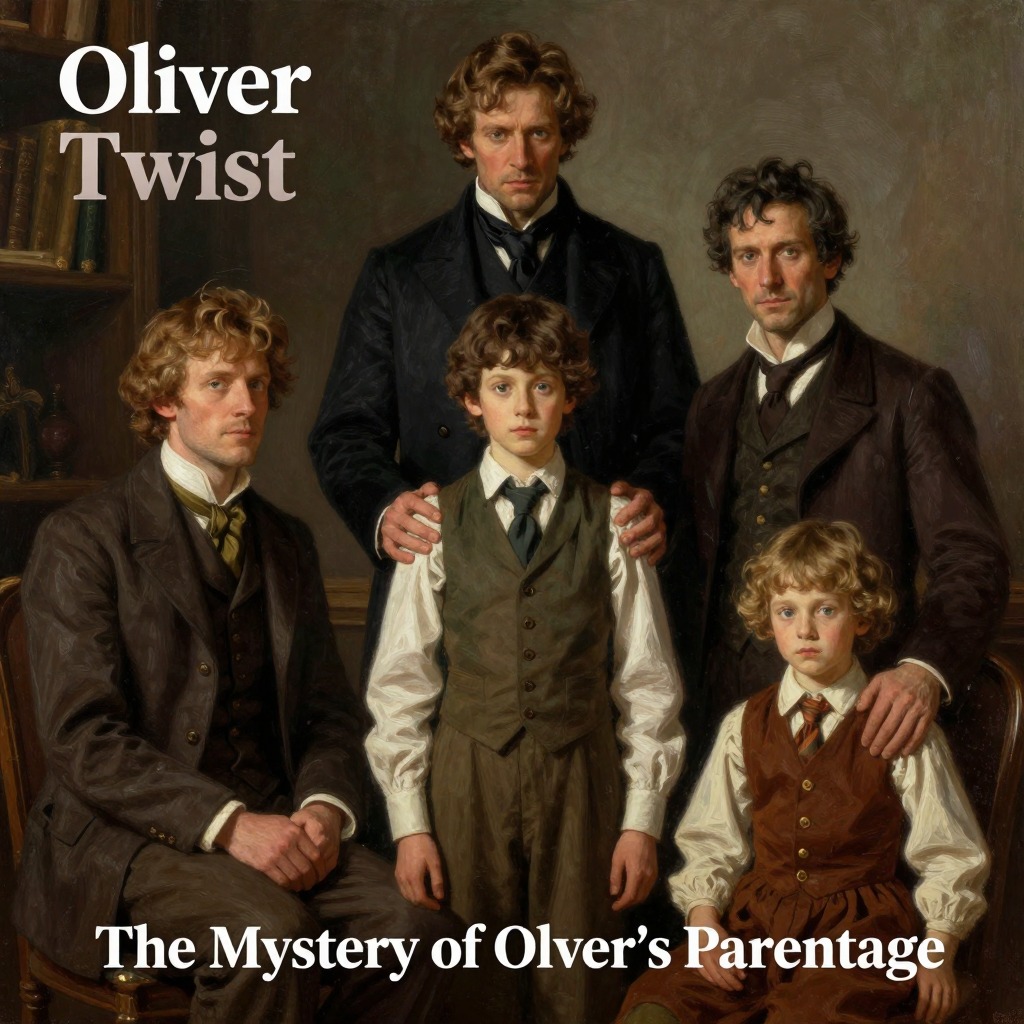
In a final meeting at the hotel in Oliver's hometown, Monks, under pressure from Mr. Brownlow, confesses the full truth. Oliver is the illegitimate son of Edwin Leeford and Agnes Fleming. Monks is their legitimate son from a separate, unhappy marriage. Edwin Leeford's will left a portion of his estate to Agnes and her child, but Monks's mother destroyed the will. The locket and ring, stolen from Agnes's corpse by Old Sally, are produced as proof. This revelation clears Oliver's name and establishes his true identity and inheritance.
During the same meeting
Rose Maylie's True Identity Revealed
Monks further reveals that Agnes Fleming had a younger sister, who was taken in by a poor family after their father's death. This younger sister, it is revealed, is Rose Maylie. Rose is therefore Oliver's maternal aunt. This revelation removes the 'stain' on Rose's name and removes the final obstacle to her marriage to Harry Maylie. The scene is one of great emotional catharsis, as Oliver and Rose embrace as brother and sister, and Rose is finally united with her true family.
Three months later
Harry Maylie and Rose Fleming Marry
With the mystery of her parentage resolved and her name cleared, Rose accepts Harry Maylie's proposal. They are married in the village church where Harry will serve as the clergyman. They move into a rustic dwelling nearby, and Mrs. Maylie comes to live with them. This happy union represents the triumph of love and virtue over the social prejudices that had previously kept them apart.
After the marriage
Oliver Adopted by Mr. Brownlow
Mr. Brownlow formally adopts Oliver as his son. They move to a house near the parsonage where Harry and Rose live, creating a close-knit, happy community. Oliver's inheritance, though reduced by Mr. Brownlow's generous decision to share it with Monks, provides him with financial security. The novel concludes with a picture of domestic bliss, with Oliver, Mr. Brownlow, Mrs. Bedwin, the Maylies, and Dr. Losberne all living in contentment near each other.
After the main events
Fates of the Other Characters
The novel concludes with brief accounts of the other characters. Monks squanders his inheritance and dies in prison in the New World. Noah Claypole becomes a professional informer. Mr. and Mrs. Bumble, stripped of their positions, end up as paupers in the same workhouse where they once ruled. Charley Bates, reformed by the horror of Sikes's crime, becomes an honest and prosperous grazier. The fates of the characters reinforce the novel's moral themes: virtue is rewarded, and vice is punished.